



High-Stakes Decisions Start Here
Site selection is one of the highest stakes calls an operator makes. A great site compounds profit for decades, anchoring customer habits, generating consistent fuel volume, and driving in-store traffic that lifts margin. A poor site quietly drains capital and management bandwidth, often for years before anyone makes the tough decision to walk away.
What the Market Data Says
- 152,255 U.S. convenience stores
- ~80% of U.S. fuel sold through this channel
- 165M daily visits; average shopper visits 3+ times per week
- VMT is steadily rising, strengthening forecourt baselines
- AI-driven location analytics are now core for major mobility retailers
Most operators are still using gut feel, static PDFs, and outdated traffic studies. The best is already using dynamic models and pulling ahead.
The Blind Spots in Legacy Playbooks
Most strategies still run on incomplete or stale inputs.
One-off traffic counts give no hour-by-hour visibility. Generic demographic reports don’t reflect actual visitor behaviour. Competitor influence zones and price pressure modelling are missing entirely. And without tying local demand to projected fuel + in-store margins, portfolios grow geographically, not economically adding sites without adding returns.
What Modern Site Intelligence Looks Like
- Hourly traffic flows, directionality, and dwell time
- Demographic and income flows by weekday vs weekend
- Competitor density, influence zones, and pricing corridors
- Greenfield vs cannibalization modelling
- Modelled site P&L: fuel volume × conversion × basket size
This turns site selection from a static map exercise into a quantified business case.

A Clear Framework for Site Decisions
Use five gates to reduce risk and make judgment consistent:
- Demand: Is there enough real traffic by hour and direction?
- Fit: Does the local audience match your high-margin missions?
- Pressure: Who influences pricing within 3–5 miles, and how stable is the band?
- Conversion: Given competition and your offer, what inside conversion is realistic?
- Return: Modelled fuel + inside margin vs. capex/opex
This approach replaces opinion with evidence and makes decisions repeatable.
Timing Is Strategy
Sales AI is one piece of the Gen-3 Retail Intelligence Platform, which also includes:
- Buy when demand is proven and competitors are underperforming.
- Build when greenfield analysis shows durable gaps you can own.
- Sell or repurpose when a site no longer clears your 24-month payback due to competitive pressure or demographic drift.
This framework keeps capital focused on compounding sites, not emotional ones.
Early Signals of a Winning Site
- Traffic timing aligns with peak missions (AM coffee, PM hot food)
- Minimal competitor overlap, stable price band
- Modelled inside conversion and basket lift justify rent/land even if fuel margins compress
If these aren’t present, future upside is unlikely no matter how good the signage looks.
Where PriceEasy Fits
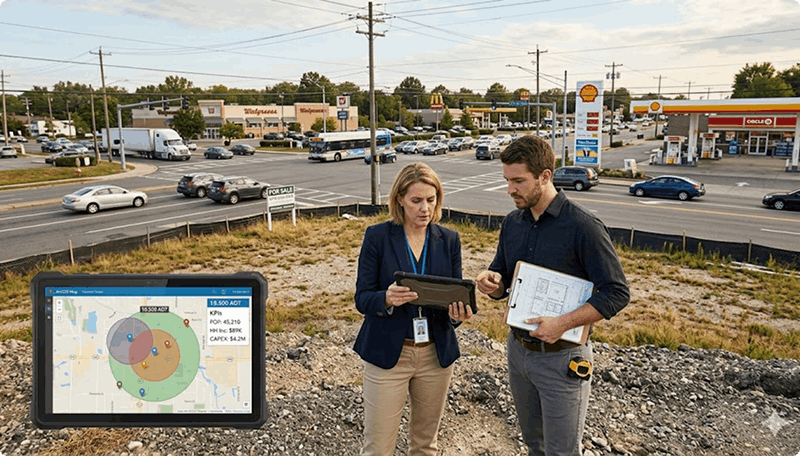
PriceEasy unifies traffic flows, demographics, mobility patterns, and competitive dynamics into one decision-grade view. It layers volume, conversion, and margin projections to reveal each site’s true economic potential, not just surface-level foot traffic or demographic counts. Instead of static reports or intuition, you get a living model of how a site will perform under real market conditions.
Conclusion
Location decisions have always been one of the most critical factors in fuel retail success. A strong site can generate decades of reliable traffic and revenue, while a poor one can quietly drain capital and management attention.
Historically, many of these decisions were made using intuition, limited market studies, or static demographic reports. Today, the availability of mobility data, competitive intelligence, and predictive analytics allows retailers to evaluate locations with far greater precision.
The operators who succeed in the next era of fuel retail will be those who treat site selection not as a guess, but as a measurable economic model. By combining data from traffic patterns, customer behavior, competitive environments, and financial projections, retailers can make smarter decisions about where to build, acquire, and invest.
In a market where margins are tight and competition is intense, the difference between a good location and a great one often comes down to the math behind it.